
Если вы заинтересованы в сотрудничестве и готовы вкладывать усилия в развитие ИИ в России, напишите нам на
info@a-ai.ru
Юридический адрес: 125009, г. Москва, пер. Романов, д.4, стр 2.
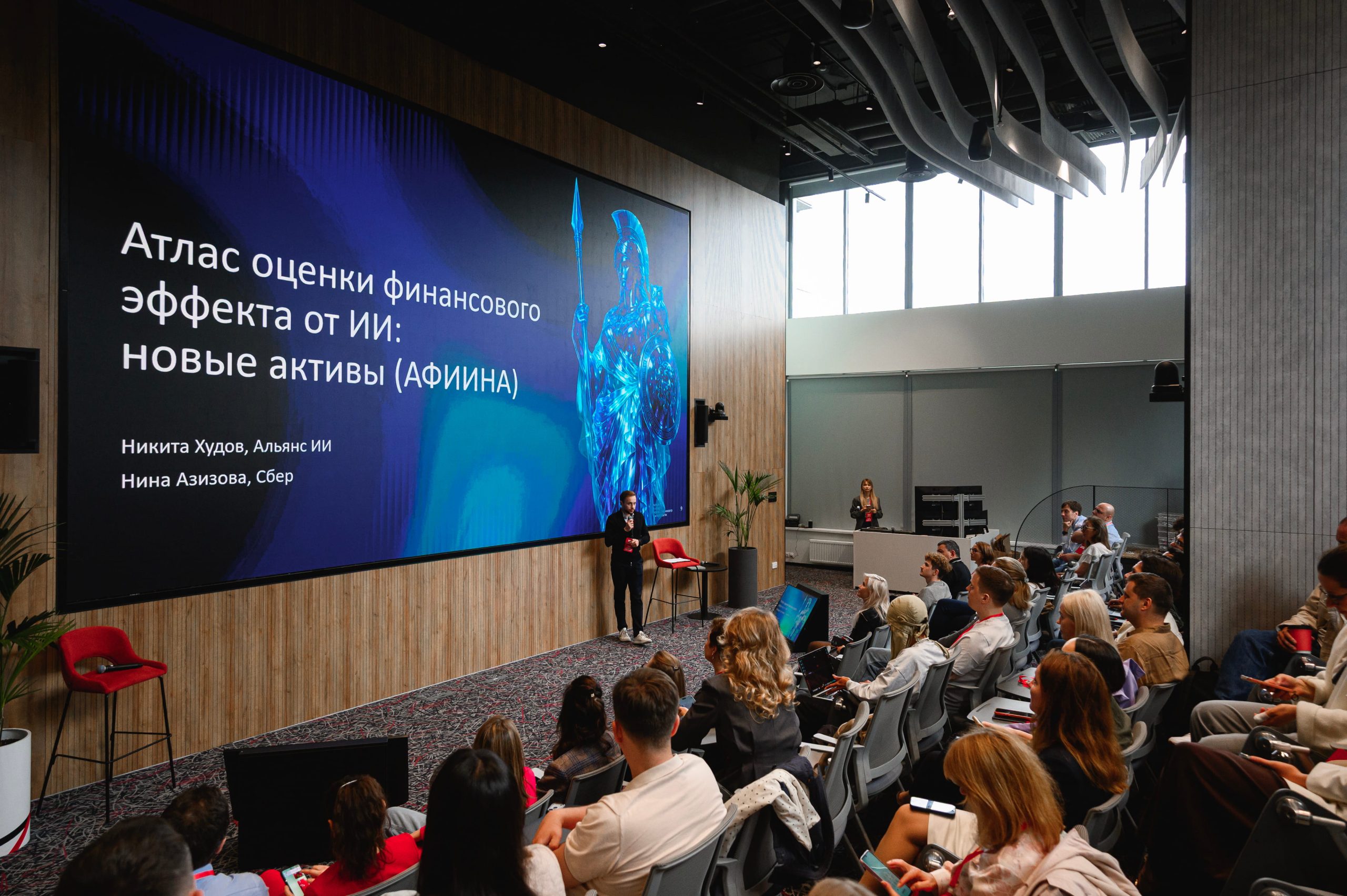
On June 16, the AI Alliance hosted a meetup titled “AI Does Have a Financial Impact” at the Alfa-Bank office, dedicated to assessing the financial impact of implementing artificial intelligence across various economic sectors. The event brought together more than 80 participants—representatives from leading companies and banks. Nikita Khudov, Deputy CEO of the AI Alliance, served as the meetup’s moderator and was one of the keynote speakers.
The tone of the meeting was set by the assertion that the impact of AI is already measurable and significant. According to industry estimates, companies that systematically implement AI are seeing exponential revenue growth and cost savings of up to 40%. Based on public data and company reports, the annual impact of AI at Sber is estimated at 475 billion rubles, while for a number of other large companies, it ranges from a few billion to tens of billions of rubles per year.
The central theme was the methodology for assessing the financial impact of AI, presented at AI Journey 2025 and adopted by more than ten companies in the financial sector. It establishes a unified assessment framework: a correct definition of the baseline scenario (“a world without AI”), a classification of eight types of financial effects linked to the P&L and balance sheet, standard formulas (ROI, NPV, payback period), typical metrics, and rules to prevent double-counting of effects.
The AFIINA project—“Atlas of Financial Effects of AI: New Assets”—represents a further development of the methodology. While the original methodology was designed primarily for the financial sector, AFIINA is a universal standard for all major sectors of the economy. The Atlas covers five industry groups:
the financial industry; retail and e-commerce; transportation and logistics; agribusiness; energy and manufacturing; and telecommunications. It consists of a core section with uniform assessment principles and industry-specific sections addressing unique characteristics.
The methodology is structured across three levels (financial, strategic, and systemic) to accommodate companies at any stage of maturity and is designed as an open knowledge base. In the practical section, company representatives (Sber, Aeroflot, Rostelecom, and others) shared their own case studies on calculating the financial impact of AI.
The host, Alfa-Bank, opened the meetup and presented a talk titled “How to Ensure the Expected Financial Impact Through Model Risk Management.” Mikhail Vasilyev, Head of the Department for Implementation, Development, and Control of AI Solutions at Alfa-Bank, emphasized that the main challenge today is not so much developing and implementing a model as it is ensuring that tangible results are consistently achieved throughout the entire lifecycle of an AI solution. This is achieved through A/B testing, validation, monitoring, and quality control of the models. Alfa-Bank used real-world examples to demonstrate how adhering to these procedures helps avoid false conclusions about the benefits.
The highlight of the meeting was a panel discussion titled “A CFO’s Perspective on Assessing the Financial Benefits of AI.” Participants included Dmitry Igolnikov, Executive Director of Sberbank’s Finance Department; Andrei Vyacheslavov, Head of Alfa-Bank’s Project Financial Evaluation Department; and Maria Subbotina, Vice President and Head of Gazprombank’s Strategic Planning Center. The speakers discussed the challenges involved in assessing the impact, why some projects get the “green light” while others do not, and how to compare the actual impact with the projected impact after an initiative is launched.
The meetup is scheduled as part of the Alliance’s regular activities. Future meetings will continue, with the goal of conducting detailed analyses of specific topics based on requests from Alliance member companies in the field of AI.
Nikita Khudov, Deputy CEO of the AI Alliance:
“Such meetings are particularly valuable because, in a single day, industry leaders exchange real, practical experience and forge new connections—and it is precisely at the intersection of different industries that powerful collaborative solutions are born. When companies openly share their assessments of AI’s impact and the mistakes they’ve already made, the entire market benefits: technology can be implemented faster and with fewer risks. The meetup received a very positive response from participants, so we plan to make such meetings a standard practice for the Alliance and hold them regularly.”
Mikhail Vasilyev, Head of the Department for Implementation, Development, and Monitoring of AI Solutions at Alfa-Bank:
“It is important for the fintech market to develop a common framework for evaluating the impact of AI: taking into account the technology’s contribution, the costs of development and maintenance, as well as the sustainability of results after launch. Alfa-Bank’s participation in the AI Alliance allows us to develop our own expertise and contribute to practices that are significant for the entire industry—such as A/B testing processes and model risk management methods.”
The meetup was attended by companies that are members of the AI Alliance: Alfa-Bank, Sber, Gazprom Neft, VK, Avito, Uralchem, PhosAgro, Norilsk Nickel, Beeline (VimpelCom), the Moscow Exchange, DOM.RF, T-Bank, Aeroflot, Rostelecom, Kaspersky Lab,
Other invited companies and partners include: Gazprombank, Rosselkhozbank, Raiffeisenbank, Samokat, Central University, and the FinTech Association (partner and co-developer of the methodology).