
Если вы заинтересованы в сотрудничестве и готовы вкладывать усилия в развитие ИИ в России, напишите нам на
info@a-ai.ru
Юридический адрес: 125009, г. Москва, пер. Романов, д.4, стр 2.
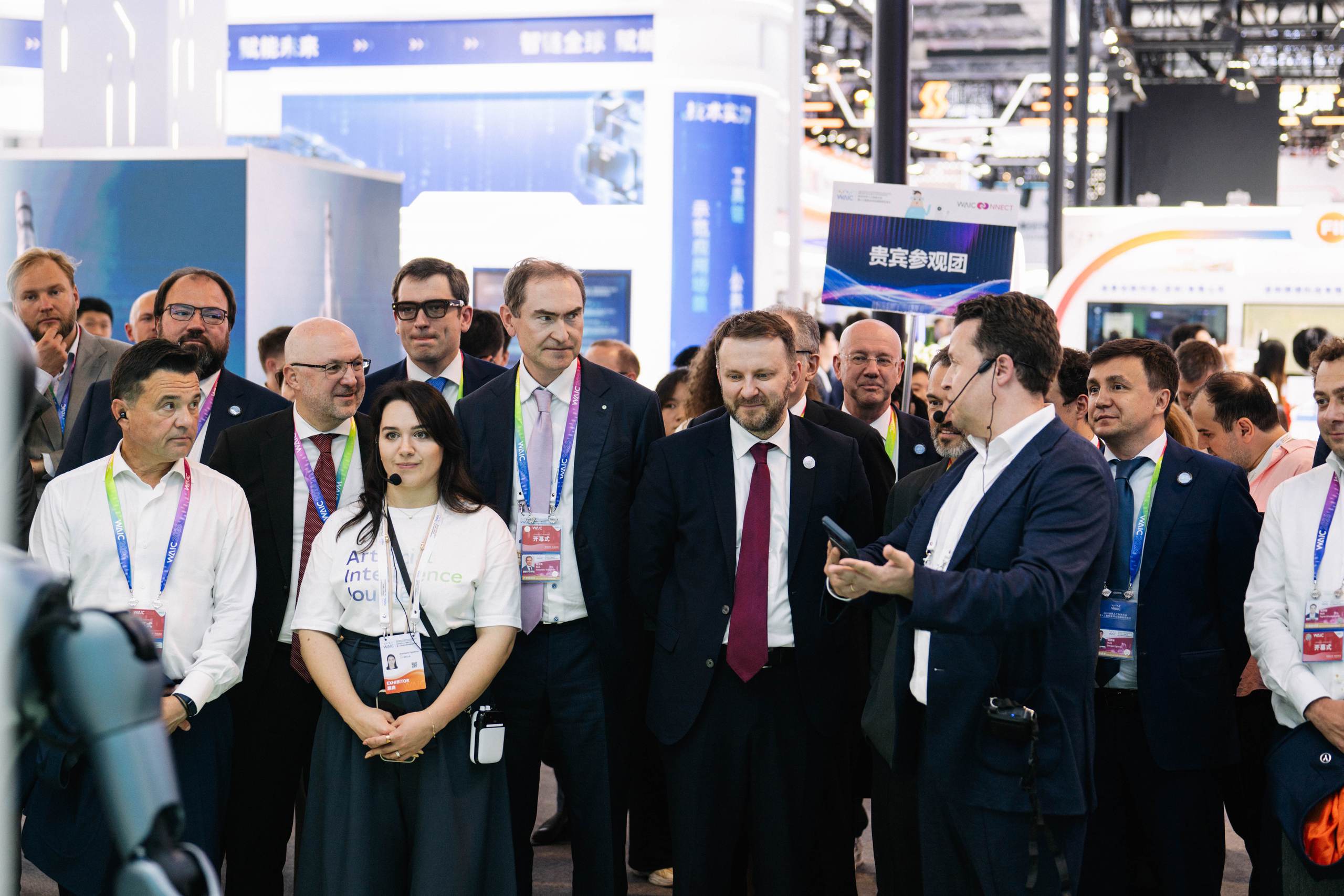
This year, as part of its participation in the World Artificial Intelligence Conference (WAIC), Russia brought to Shanghai not just individual projects, but a full-fledged national AI technology stack—ranging from flagship language models and agent platforms to anthropomorphic robots and biometric solutions. Alexander Vedyakhin, First Deputy Chairman of the Management Board of Sberbank, spoke about this in an interview with GeekPark, emphasizing that Russian AI has moved from isolated solutions to systematic expansion into international markets.
Alexander Vedyakhin, First Deputy Chairman of the Management Board of Sberbank:
“Russia showcased a new AI stack at WAIC 2026. For the first time, we brought not just disparate products, but an integrated ecosystem—from foundational models to physical agents. This is a declaration of technological sovereignty. We are not playing catch-up; we are shaping our own architecture for the future of AI.”
The key highlight of the Russian exhibition was the flagship language model GigaChat 3.5 Ultra, based on a hybrid architecture with linear attention. The new product, presented at the AI Journey booth, is 40% more compact than the previous version, half as heavy, and generates long texts four times faster, demonstrating significant improvements in coding, mathematics, and agent-based scenarios.
However, the Russian stack is not limited to a single model. The joint booth also features developments from Alliance partners in the field of AI: the Alisa AI family and the open-source YandexGPT 5 Lite from Yandex; the T-Pro 2.1 and T-Lite models from T-Bank; and the generative solutions Kandinsky 3D and Cadrille from the AIRI Institute for 3D modeling based on text descriptions.
The main technological trend that Russia demonstrated at WAIC is the transition from chatbots to digital agents capable of independently performing multi-step tasks. Practical results are already evident: for example, Sberbank issued Russia’s first fully autonomous corporate loan without the involvement of a bank employee. The booth features the GigaNetwork agent platform, where AI agents from various companies negotiate and close deals, as well as the self-developing GigaAgent, whose evolution visitors can observe in real time. In the physical world, the Russian stack is represented by the anthropomorphic robot Green, equipped with Green-VLA technology, which—after a presentation to the President of Russia—acquired new skills and became one of the exhibition’s main “AI highlights.”
At the same time, as Alexander Vedyakhin emphasized, developers consciously adhere to the principle of “controlled autonomy.” In high-stakes areas—healthcare, heavy industry, and supply chain management—agents are not yet granted complete freedom. Humans retain final control over strategic decisions, while AI handles routine tasks, speeding up document processing by up to 80% and saving employees up to 81.5% of their working time.
Alexander Vedyakhin, First Deputy Chairman of the Management Board of Sberbank:
“WAIC 2026 confirmed that the world has shifted from discussing the possibilities of AI to addressing accountability. Today, all major players are looking not for ready-made answers, but for partners to co-create solutions. Russia and China are focused on the reliability of agent systems, and our cooperation is moving into the practical realm—from regulatory dialogue to joint product initiatives, including the integration of Alisa into Chinese-brand vehicles.”
According to Alexander Vedyakhin, this year’s Russian exhibition at WAIC was not merely a showcase of individual achievements, but proof that Russia has developed a fully-fledged AI industry—ranging from fundamental research to ready-made industrial solutions that are competitive on a global scale.