
Если вы заинтересованы в сотрудничестве и готовы вкладывать усилия в развитие ИИ в России, напишите нам на
info@a-ai.ru
Юридический адрес: 125009, г. Москва, пер. Романов, д.4, стр 2.
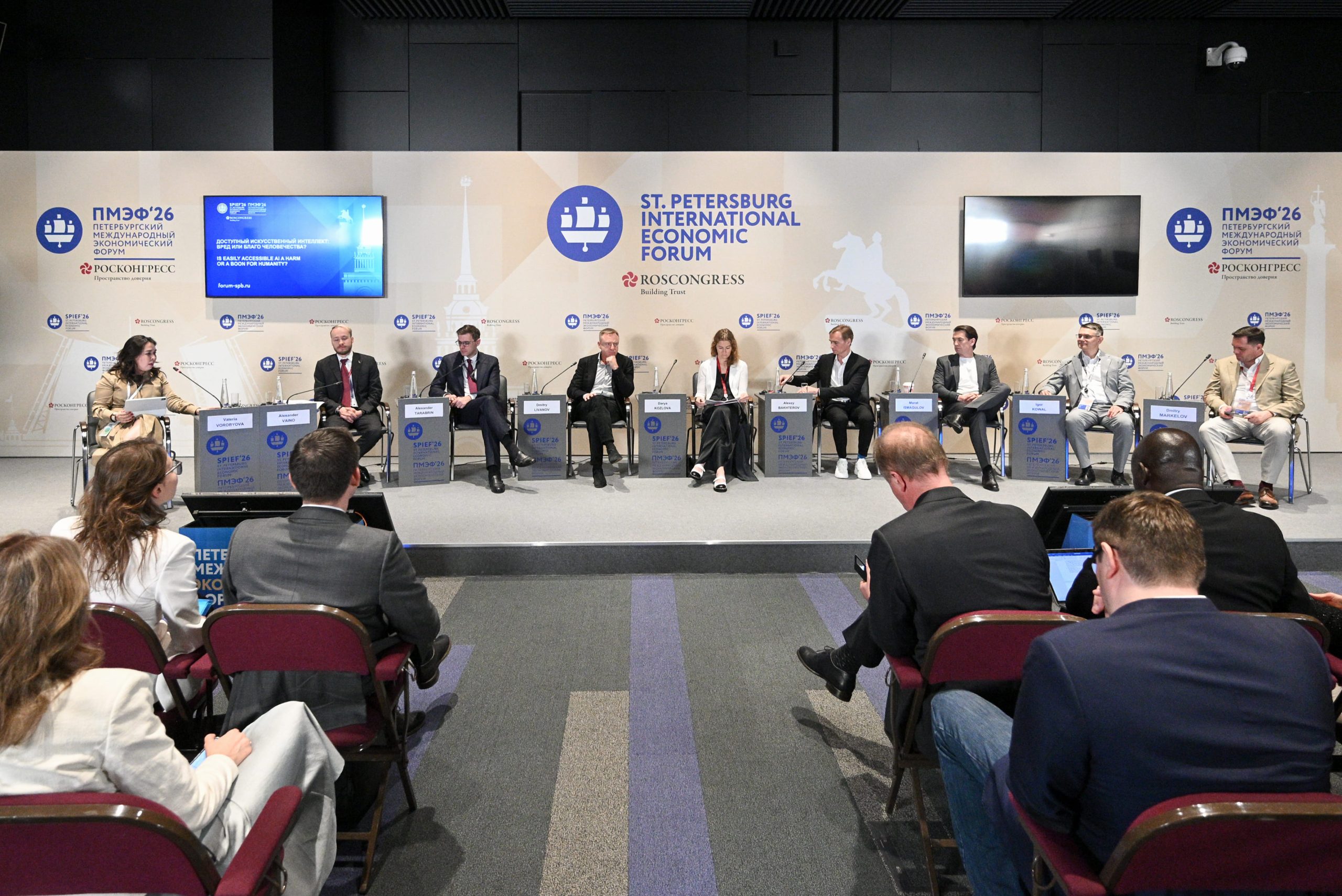
On June 4, 2026, as part of the St. Petersburg International Economic Forum, a panel discussion titled “Accessible Artificial Intelligence: A Blessing or a Curse for Humanity?” took place. The discussion was moderated by Valeria Vorobyova, CEO of the Artificial Intelligence Alliance.
Participants in the discussion included Alexander Vaino, Director of the “Young Professionals” division at ASI; Alexander Tarabrin, Head of the Prosveshchenie Publishing House; Dmitry Livanov, Rector of the Moscow Institute of Physics and Technology (MIPT); Daria Kozlova, Director of Education at Yandex; Marat Ismagulov, HR Director and Deputy Chairman of the Management Board at Alfa-Bank; Alexey Bakhterov, President of Media Instinct Group; Igor Koval, Director of the Education Department at RVB; and Dmitry Markelov, Director of Government Relations and Corporate Governance at Headhunter.
Opening the discussion, Valeria Vorobyova set the framework for the conversation: “AI opens up new opportunities for people in the fields of education, creative learning, and professional development—in general, it helps people find their calling. But it’s not that straightforward, and the key question is: does accessible AI help people develop, or, on the contrary, does it cause them to regress?”
During the discussion, experts addressed the impact of AI on the education system and the labor market, as well as the limits of technology’s application in the educational process. Topics discussed included the cognitive risks of replacing learning with the search for ready-made solutions, the problem of data inaccuracy and threats to academic standards, as well as the opportunities AI offers for personalizing educational pathways and reducing routine tasks.
Addressing the sensitive topic of AI’s application in the educational process, Alexander Vaino noted: “What is needed is not piecemeal measures, but the development of a new model of education in which AI will help achieve results in increasing labor productivity and overcoming labor shortages. School education will be the first element of this model.”
Following the discussion, participants agreed that the question “Is artificial intelligence a blessing or a curse?” is no longer relevant: the technology has already become a reality, and the key task is to apply it in a way that benefits people.