
Если вы заинтересованы в сотрудничестве и готовы вкладывать усилия в развитие ИИ в России, напишите нам на
info@a-ai.ru
Юридический адрес: 125009, г. Москва, пер. Романов, д.4, стр 2.
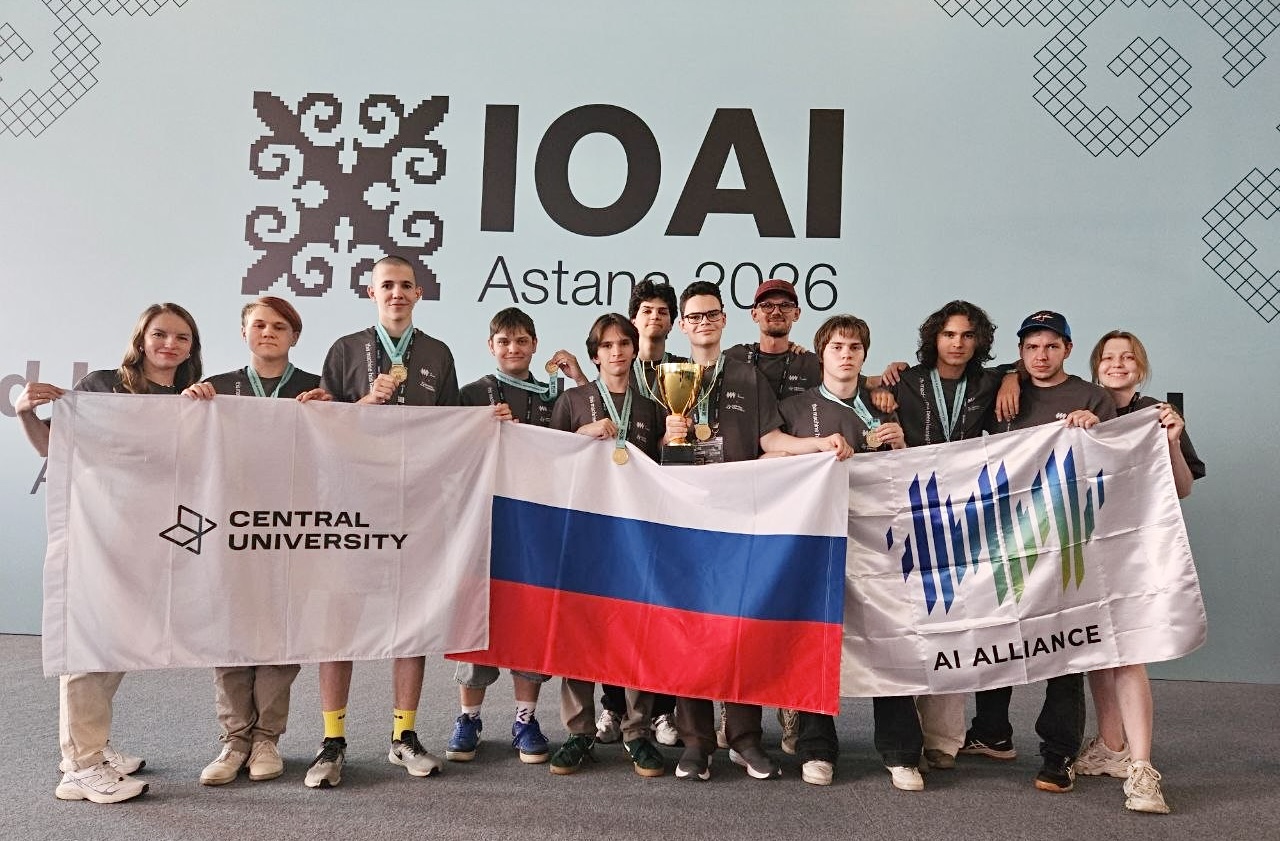
The Russian team won 8 medals—7 gold and 1 bronze—at the International Artificial Intelligence Olympiad (IOAI) for high school students, which took place in Kazakhstan from August 2 to 7. A member of the Russian team also became the overall winner of the IOAI. The Russian team took first place overall, with the team from China in second place and the team from Poland in third.
This is the third time the Olympiad has been held, and the Russian national team has won the championship every year. As is tradition, the team was prepared by experts from the Artificial Intelligence (AI) Alliance and Central University.
In the finals, the Russian team competed against 465 talented high school students from 105 countries, including Argentina, Australia, Denmark, Kazakhstan, China, the Netherlands, Norway, the Republic of Korea, Spain, Sweden, Switzerland, the UAE, the United Kingdom, and the United States. This is a record number of countries in the competition’s history. The number of students this year exceeded last year’s total by 64%. The IOAI has moved into second place in terms of participant numbers among global Olympiads; first place is held by the International Mathematical Olympiad (IMO), which was held for the 67th time this year.
The IOAI finals took place over two days and consisted of two individual rounds. Each round lasted six hours and included three problems. The first round focused on working with audio, controlling robots in a virtual environment, and semantic word search. In the second round, participants performed an adversarial attack (a covert modification of input data to influence a model’s behavior) on a computer vision model, developed an algorithm to detect text generated by large language models, and generated various versions of the Olympiad logo.
The tasks covered key areas of artificial intelligence and required a solid command of various machine learning methods.
Medals at the International AI Olympiad were awarded to the winners and prize recipients of the All-Russian AI Olympiad, the Asia-Pacific Olympiad in Artificial Intelligence (APOAI), the AI Challenge—an international AI competition for children and youth—and other prestigious Russian and international Olympiads and competitions in the field of AI.
Gold medalists:
Bronze medalist:
The team roster for the IOAI was determined during the Northern Eurasia OAI 2026 (NEOAI) qualifying competition held at SberUniversity. The event brought together 60 talented high school students from 23 cities across Russia, who successfully passed the selection process based on the results of a three-day qualifying round. The competition was also available online to participants from other countries. A total of 164 candidates from 17 countries took part in the remote stages of the competition.
The final roster of the Russian national team for the IOAI underwent two months of intensive training for the international competition, following an individualized program developed by leading experts from Central University.
The participants were also trained by experts from Central University and AI-focused companies within the Alliance, who had previously prepared the winners of the International Artificial Intelligence Olympiad in 2024 and 2025. Leading specialists in the field of artificial intelligence from Russian and international organizations also joined the training effort:
Following the results of the International Artificial Intelligence Olympiad, it was announced that in 2027, Central University, in collaboration with the Artificial Intelligence Alliance, will host the Asia-Pacific Artificial Intelligence Olympiad in Russia. This is the first time in the history of the Olympiad that a country will host the competition on its own territory—previously, it was held online. The APOAI is part of the IOAI system and is held under its auspices, following uniform rules and standards. The International AI Olympiad brings together more than 40 countries and four regional competitions: for the Asia-Pacific, European, African, and American regions. Countries may use these competitions as an official qualifying round for the IOAI finals. Only organizations accredited by the IOAI are granted the right to host such Olympiads.
APOAI is a young but rapidly growing international Olympiad created to identify and support talented high school students interested in artificial intelligence. The competition is modeled after the International Olympiad in Artificial Intelligence: participants solve problems related to machine learning, data analysis, and the practical application of AI. The Olympiad is held annually, and the right to host it rotates among countries and territories in the region. In 2026, China organized the first APOAI.
The Asia-Pacific Olympiad will take place in April 2027 in a hybrid format: in Russia and at official venues in the participating countries. In addition to the competition program, the organizers will prepare educational events for students and team leaders.
Dmitry Chernyshenko, Deputy Chairman of the Government of the Russian Federation:
“I congratulate our young athletes on their outstanding performance and brilliant triumph! The Russian national team emerged as the best among representatives from more than 100 countries. Our medalists have demonstrated their mastery at the world level. It is particularly significant that these awards were received in hospitable Kazakhstan—President Vladimir Vladimirovich Putin emphasizes the importance of humanitarian ties with that country, especially in education. I would like to note that today, artificial intelligence has become a reliable assistant to humans—and it is precisely talents like the winners and medalists of this Olympiad who will drive technology forward. For its part, the Government will continue to create conditions for young people to realize their potential in this field through measures under the national projects “Youth and Children” and “Data Economy and Digital Transformation of the State.”
Sergey Kravtsov, Minister of Education of the Russian Federation:
“I congratulate our high school students on their strong performance at the 3rd International Artificial Intelligence Olympiad in Kazakhstan! Just as they did a year ago, these high school students reaffirmed their status as one of the world’s strongest teams by winning eight medals, including seven gold medals. It is precisely in such intense and fair competition that true talent shines through: here, it’s not enough to simply know the theory—you need to think quickly, find unconventional solutions, and not be afraid of complex problems. The ability to work with AI is becoming an essential skill today. It’s about critical thinking, which makes a person stronger than any technology. It is precisely these skills that you demonstrate at the Olympiad, and it is precisely these that will become your main advantage in the future—in science, in engineering, and in any profession where you need to create something new.”
Alexander Vedyakhin, Chairman of the Supervisory Board of the AI Alliance, First Deputy Chairman of the Management Board of Sberbank:
“The convincing victory of Russian high school students for the third consecutive year at the Artificial Intelligence Olympiad is an indicator of the high level of development of our national artificial intelligence. This year, the competition intensified significantly, but our students once again proved to be the strongest at solving problems at the very forefront of technology. The generation that is winning on the world stage today will shape Russia’s technological landscape tomorrow. We congratulate the winners and invite them to Russia’s largest international conference on artificial intelligence, AI Journey.”
Valeria Vorobyova, CEO of the Artificial Intelligence Alliance:
“Our students consistently place highly in tournaments of this caliber year after year. Behind this consistency is always a well-functioning training system that allows us to identify talented young people in AI at an early stage and develop them to a world-class level. The Alliance’s mission is to develop this mechanism so that top-tier specialists emerge predictably and in sufficient numbers, and so that businesses can rely on them as a real human resource that, in a few years, will determine the level of domestic technology.”
Evgeny Ivashkevich, Rector of Central University:
“I congratulate the Russian national team on their successful performance at the International Artificial Intelligence Olympiad. This year, the competition was particularly fierce: students from a record number of countries participated, and the tasks covered the most cutting-edge areas of artificial intelligence development—from computer vision and speech processing to working with large language models.
For several months, the students worked under the guidance of leading experts from Central University and our partners, solving problems that closely mirrored those currently faced by researchers and engineers in the field of AI. We are delighted that this work helped the Russian team represent the country with distinction on the international stage. It is particularly symbolic that next year Russia will host the Asia-Pacific Artificial Intelligence Olympiad, with Central University and the AI Alliance serving as its organizers. For us, this is an opportunity not only to showcase the high level of Russia’s AI education system but also to bring together talented students and experts from different countries around cutting-edge technologies and education.”
Stanislav Bliznyuk, Head of T-Bank:
“The Russian national team has become the champion of the World AI Olympiad for the third time in a row. Behind every medal lies hard work, discipline, and months of preparation by the participants themselves, as well as their mentors and coaches.
This victory demonstrates our country’s potential and the level of development in education and technology. For us, it represents a contribution to the development of a professional community of young specialists who are already capable of solving world-class problems and strengthening Russia’s technological sovereignty. We see how rapidly artificial intelligence is developing, and we are confident that these students will be creating new technologies in the coming years. I congratulate the students and hope that this victory will mark the beginning of a great journey in science, technology entrepreneurship, and their professional careers.”